
Remove water vapour where it starts. Exhaust cooking and bathing moisture outdoors, verify fan airflow and duct termination, and dry the window before repeated wetting damages finishes.
Alongside the specific checks in Kitchen and Bathroom Window Frost: Control Moisture at the Source, review ice on windows and compare that guidance with measured conditions in this home.
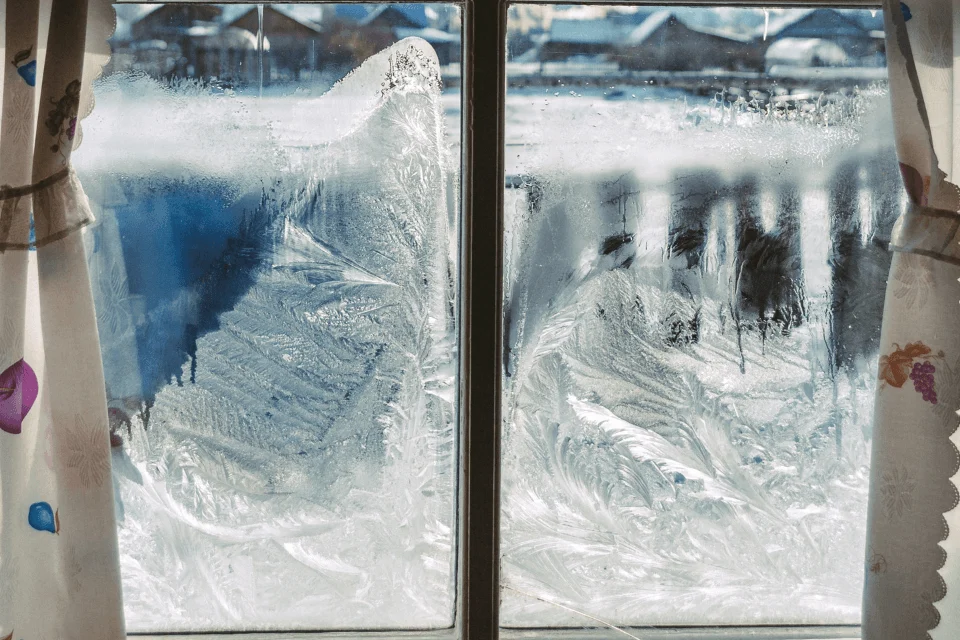
Why the frost pattern matters
Start with the pattern, not the purchase decision. Window ice begins as a surface-temperature problem. Indoor air carries water vapour; when that air meets a surface below its dew point, liquid condensation forms. If the surface is below freezing, the water becomes frost or ice. Natural Resources Canada notes that colder weather and higher indoor humidity both increase the risk.
Health Canada recommends controlling indoor dampness and uses 30 to 50 percent relative humidity as broad household guidance. That range is not a frost guarantee: during severe cold, some window and wall assemblies need a lower indoor level. Natural Resources Canada publishes temperature-dependent examples, so weather and whole-window performance must stay in the diagnosis.
Evidence to collect:
- Frost follows cooking or shower schedules.
- Mirror and glass stay wet long after activity.
- Exhaust grille has weak draw.
- Water collects on wood or drywall below the unit.
Within the diagnostic path for Kitchen and Bathroom Window Frost: Control Moisture at the Source, use location and timing to distinguish ice on inside of house windows from between-pane moisture, uncontrolled air leakage, or a room-specific airflow problem.
Practical response
- Use lids and the range hood while cooking.
- Run the bathroom fan during and after showers.
- Inspect exterior dampers for blockage.
- Keep window coverings open during moisture events.
- Document whether frost falls after fan maintenance.
Illustrative scenario
Illustrative scenario: a kitchen slider frosts during large family meals but stays clear on ordinary days. The range hood recirculates indoors and a blind covers the window. Source control and airflow changes provide a direct, testable response.
What not to assume
A fan that makes noise may still move little air because of clogged grilles, long restrictive ducts, stuck dampers, or an indoor recirculating configuration. Verify the airflow path rather than assuming operation from sound.
When professional help makes sense
Call a ventilation contractor when exhaust is weak, noisy, or not terminated outdoors. Call a window specialist when the unit leaks air, will not close, or remains the only frosted opening after moisture control. For a review centred on Kitchen and Bathroom Window Frost: Control Moisture at the Source, bring photos and measurements plus the reference steps for frost forming inside windows; the visit can then begin with evidence rather than a generic replacement assumption.
Frequently asked questions
Does boiling water affect windows?
Yes. Cooking adds water vapour; use lids and an exhaust hood that vents outdoors.
Can I wipe frost and ignore the cause?
Wiping protects materials temporarily, but repeated frost requires moisture, airflow, temperature, and window checks.
What if only the bathroom window frosts?
Begin with shower moisture, fan performance, room temperature, and covering position, then inspect the opening if it remains abnormal.
Suggested internal links
Custom Fit Windows
Benefits of Double Glazing
Authoritative sources
Health Canada – Guide to addressing moisture and mould indoors
Health Canada – Ventilation and the indoor environment
Natural Resources Canada – Condensation
